Friday, 6 February 2009

Friday, 6th February: "Dear Landlord..."

Today in 1935....

"Best-selling commercial board game, Monopoly, went on sale for the first time"


http://phd.blog.googlepages.com/monopoly_board.jpg

That's right: Monopoly, one of the world's most tedious board game experiences, is 74 years old.

But is it? Here's some official promo-flab from Hasbro, who market the game in the UK:
Today, it's the best-selling board game in the world, sold in 103 countries and produced in 37 languages including Croatian. But where did the MONOPOLY game come from? How did this phenomenal pastime get its start? MR. MONOPOLY tells the legend best:

If you want to understand the spirit of Monopoly, look no further than its creator. Charles B. Darrow was one of many unemployed Americans who lived during the Great Depression. Life was bleak, but Darrow had a big idea: a game that would let everyone enjoy a taste of the high life. In 1934, he took his game to Parker Brothers but they rejected it because it didn't meet their standards. Not a man to quit at the first obstacle, Darrow made a deal with a local printer and had 5000 sets made, which he sold to a Philadelphia department store. People loved the game and news of its success soon got back to Parker Brothers. They negotiated a deal and, as a result, both their fortunes were made. Today MONOPOLY is still the world's number 1 board game.
Leaving aside the bizarrely chosen hyperbole (27 languages INCLUDING CROATIAN?!?!?), and ignoring obvious inaccuracies (describing Monopoly as a "phenomenal pastime", claiming that the game "let[s] everyone enjoy a taste of the high life"), this obviously simplified version of events ignores the notion that games similar to Monopoly were fairly widely played at home at the beginning of the twentieth century. A sadly unsourced wikipedia cites the most famous pre-Monopoly game called The Landlord's Game created and patented by Elizaberth Magie, a Quaker:
The Landlord's Game is a board game patented in 1904 by Elizabeth Magie. It is a realty and taxation game, similar to Monopoly. Though many similar home-made games were played at the beginning of the 20th century and some predate The Landlord's Game, it is the first of its kind to have an attested patent. Magie re-patented a revised edition of the game in 1924. The United States Patent numbers are 748,626 and 1,509,312.

Magie based the game on the economic principles of Georgism, a system proposed by Henry George, with the object of demonstrating how rents enrich property owners and impoverish tenants. She knew that some people could find it hard to understand why this happened and what might be done about it, and she thought that if Georgist ideas were put into the concrete form of a game, they might be easier to demonstrate.
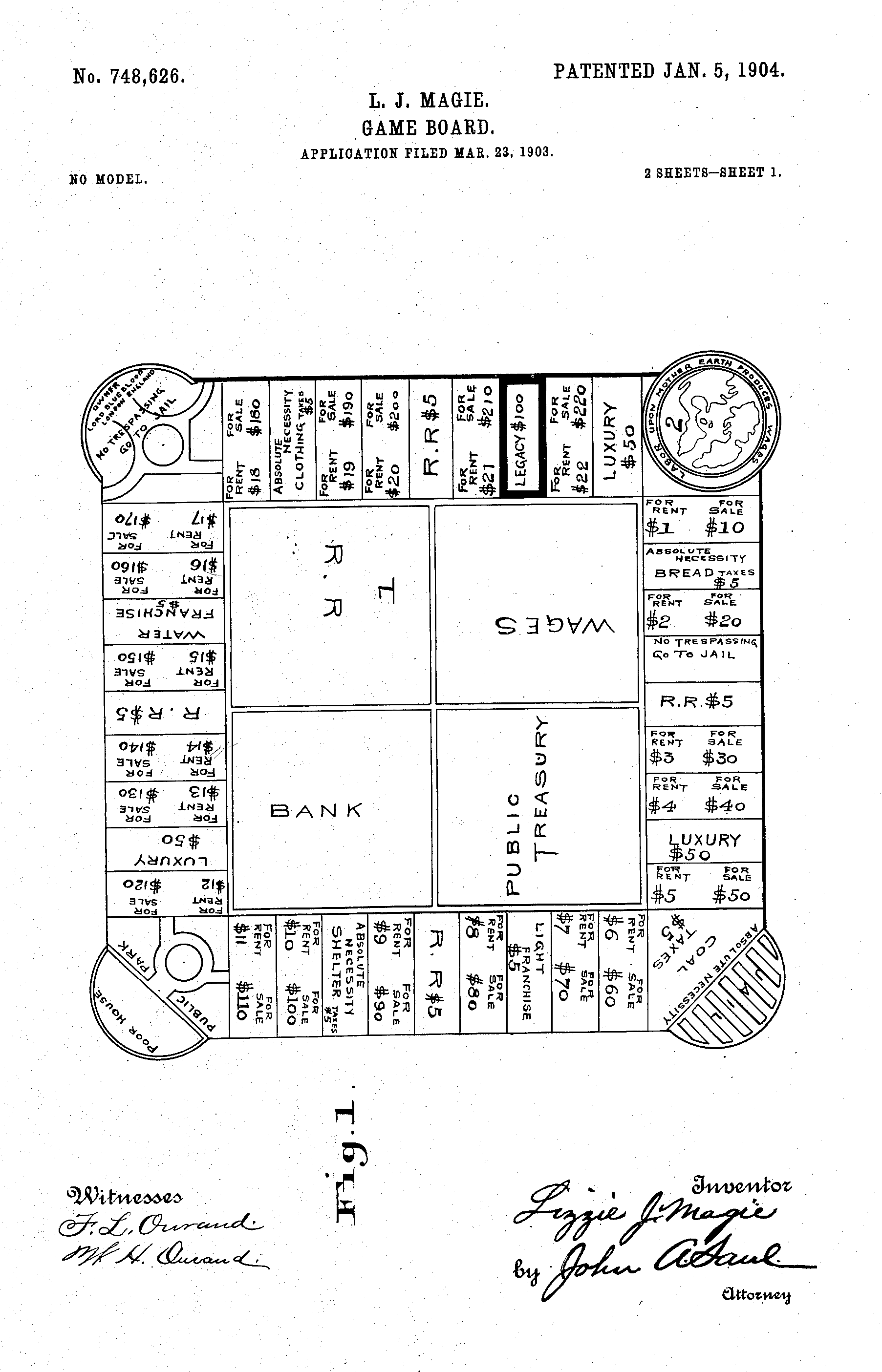
File:BoardGamePatentMagie.png

A patent drawing for The Landlord's Game

Fairly radical, no? There's a lot to love about Quakers. This game was passed around for a while at the beginning of the century, and then... well, then the rags-to-riches story of Charles B Darrow kicks off. A website called The Idea Finder takes the second half of the story up (after, it turns out, providing the text for the above-quoted wikipedia article):
In 1933, Charles B. Darrow played a game on oil cloth on his kitchen table, fell in love with the game's exciting promise of fame and fortune. He played "Monopoly" at home with his family and friends. But others soon heard of the game and ordered sets of their own. Later that year Charles Darrow patented and sold copies of the game as his personal invention. Darrow went to work, making hand-made copies of Monopoly and selling them for $4.00 apiece.

When demand for the game grew beyond his ability to fill orders, he brought the game to Parker Brothers who first rejected it on the basis there were 52 design errors. Undaunted, Darrow continued to produce handmade editions on his own and was highly successful. Parker Brothers caught wind of the success and decided to buy the rights to the game. In 1935, owned by Parker Brothers, the MONOPOLY® game became America's best selling game. Parker Brothers subsequently decided to pay off Magie, and others who had copyrighted commercial variants of the game, in order to have legitimate, undisputed rights to the game, and promoted Darrow as its sole inventor.

But hang on!
"A game surprisingly similar to Darrow's and known as Monopoly was played on homemade boards in the DKE house at Williams College in 1927 et seq. It developed in Reading, Pa., much earlier than that.

"Almost exactly this same game as played at Williams was put on the market in Indianapolis early in 1932 through L. S. Ayres & Co. The name was changed to Finance for trademark reasons. Dan Layman's predecessor Finance. That cost more money: $10,000. But none of it went to Layman. A victim of the Great Depression, broke and desperate for money, he had sold his interest in Finance to a small games manufacturer, David W. Knapp, for $200.

This is getting complicated.
Once Finance was wrapped up, Parker Brothers turned to another Monopoly-like game called "Inflation," manufactured by a Texan named Rudy Copeland. Early in 1936 Parker Brothers sued Copeland for patent infringement. Copeland countersued, charging that Darrow's and therefore Parker Brothers' patent on Monopoly was invalid. If the details forming the basis for that charge had become public knowledge, Parker Brothers might never have gone to reap a fortune from Monopoly. But Parker settled the lawsuit immediately by paying Copeland $10,000 to surrender his rights and keep his mouth shut.
Whoah! And a final word on this ugly little game?
Decades later, when they [Parker Bros] attempted to suppress publication of a game called Anti-Monopoly, designed by Ralph Anspach, the trademark suit went all the way to the Supreme Court of the United States in 1983, and the court found in favor of Anspach because Darrow did not actually invent the game.
Whammo! Litigously sordid! Thanks, Idea Finder!!

There's even more depth on the whole story, with rules to preliminary versions of Monopoly, on this site.

I'm with this guy at his blog, Lutheran Surrealism, who decides the following after two of his children refused to continue playing:
"I'm against monopolies, and I realized while playing the game that it taught something evil. The idea is to control all the properties on the board, and squeeze the viability out of your playing partners until you win, by forcing them all out of business. Perhaps my two boys knew something, or sensed something, after all, about the game."

"It's a wicked, wicked game."

AND A BLOODY GREAT QUOTE FOR YOUR WEEKEND:

"What matters is being right, not being told you are"

Which is useful, as very few people tell me I am right.

Thursday, 5 February 2009

Thursday, 5th February

Today in 1953...

"Sweet rationing ended in Britain after ten years"


http://farm3.static.flickr.com/2058/2229372024_b5c70fe7fa.jpg?v=1201736689

From the BBC "On This Day" microsite:
"Rationing came into force on 8 January 1940, a few months after the start of World War II.

All sorts of essential and non-essential foods were rationed, as well as clothing, furniture and petrol. Rationing of sweets and chocolate began on 26 July 1942.

The process of de-rationing began in 1948, but made slow progress until 1953. Then Food Minister Gwilym Lloyd-George made it a priority for his department.

As well as sweets, he took eggs, cream, butter, cheese, margarine and cooking fats off the ration books."

and the quote....

"Never light a fire you can't put out"

An anonymous quote again (in which case it was probably Churchill), searching for this in quotes yields 5 results. They are, in full:
  • Part of the "signature file" on a website about New Eden, which seems to be a game based on the BBC series Torchwood. Not sure what this means, as the network at the office bans sites about gaming. I suspect it's part of a file which randomly generates signature quotes on forum postings, or something.
  • A chinese blog consisting of softcore pictures of gay western men
  • "Thought for today" from user foxylady on 20six.com (most likely from her desk calendar, I reckon)
  • A page from the defunct-seeming (ie it won't load and all I have to go on is the google search result) theMSSforum.com site. The full text of the search result is "somthing[sic] new a drunk isirsh[sic] man onced[sic] said never light a fire you can't put out you will learn somthing[sic] new everyday[sic] Tag: Where are you? Tag: 111332 ..."[sic]
  • The 15th page of a thread from 2007 in a Maximo Park forum. It seems like somewhere around page 4 or 5, someone began a discussion about bandmember Paul not speaking to fans outside the Manchester gig. User purdylola said:
    "Went round the back after and waited over two hours for them to come out. At one point Paul appeared with two girls but he had his head down and swiftly passed through so we assumed he would come back after, but he never did!!!! However i did meet Archis and adorable Duncan who i spoke to for about 20 minutes. Lukas and Tom were also buzzing around. But seriously, what the hell Paul!!!!!! V disappointed, not what i expected, he upset some fans tonight."
    Which obviously 'ignited' a discussion. Ten pages of forum posting later, someone throws that "Dont start a fire" quote right in her face. Nice one!

Wednesday, 4 February 2009

Wednesday 4th February!!!

Today in 1974...

"American Heiress Patty Hearst was kidnapped by urban guerillas"


Heiress-cum-urban-guerilla, Patty Hearst

Well, I've been away a while... Blame both the snow, which has crippled our nation, and my own laziness, which has crippled my advance through life.

Anyway, i can't turn down a good hostage story, so...

Patty Hearst was an heiress to the Hearst publishing empire established by William Randolph Hearst (the inspiration for Citizen Kane), who was her Grandfather.

The timeline of her kidnapping is extraordinary. She was kidnapped on this day in 1974 and by April she was caught on security camera (above), appearing to take part in an armed robbery of the Hibernia Bank in the Sunset District of San Francisco. Her journey from victim to apparent collaborator ("Tania") was quick to say the least. The organisation which took Hearst, the Symbionese Liberation Army, demanded a food program be set up for the poor people of California and in the ensuing weeks Hearst's public pronouncements, which appeared to side with her captors, enthralled the press and public - and probably confounded her father.

The best place for infos is definitely the PBS microsite for the documentary "Guerilla: The Taking of Patty Hearst" including a timeline, resources (the Rolling Stone 1975 article is fascinating) and a bizarre and incredibly basic role-playing game called "What's Your Bag?" where you choose whether you want to be a revelutionary or not...

Here's some video, too, of contemporaneous CBS coverage of the kidnap:


Click on for Parts 2, 3, 4, 5 and 6

And some more video here:


And today's "daily desk quote":

"Conscience is the inner voice that warns us someone may be looking" - H. L Mencken

My conscience is telling me I should get back to work having wasted an entire afternoon looking up stuff about Patty Hearst.

Thursday, 22 January 2009

Thursday, 22nd January

On this very day in 1905...

"The Russian Revolution began on 'Bloody Sunday'"

http://upload.wikimedia.org/wikipedia/commons/2/29/Bloody_Sunday_Russia_1905.png

Wikipedia, oh help me please!!
Bloody Sunday (Russian: Кровавое воскресенье) was an incident on January 22 [O.S. January 9] 1905 in St. Petersburg, Russia, where unarmed, peaceful demonstrators marching to present a petition to Tsar Nicholas II were gunned down by the Imperial Guard. The march was organized by Father Gapon, who had collaborated with Sergei Zubatov of the Okhrana, the Tsarist secret police, to create workers' organizations[1] and thus considered by some to be its agent provocateur. Bloody Sunday was an event with grave consequences for the Tsarist regime, as the blatant disregard for ordinary people shown by the massacre undermined support for the state.
Whilst I use wikipedia on matters of history, I must point out that the most interesting parts of the entry are on the talk page. This often happens, especially when articles ar so hopelessly put together as this one. When someone is moved to write "1000 dead? Seriously? Most books I have read have placed it at around 200. Anyone have any evidence to back up the 1000 dead claim?" then you know you're dealing with a heightened level of contentiousness - with a certain degree of haziness.

It helps, sometimes, to read both pages if you're serious about using wikipedia. And of course check as many of the citations at the bottom as possible!

Instead, I'll round off with something I found elsewhere, a passage from"The Story of My Life" by Father George Gapon, who organized the march. It illuminates the story far better than any endlessly peer-reviewed user-edited encyclopedia:
The procession moved in a compact mass. In front of me were my two bodyguards and a yellow fellow with dark eyes from whose face his hard labouring life had not wiped away the light of youthful gaiety. On the flanks of the crowd ran the children. Some of the women insisted on walking in the first rows, in order, as they said, to protect me with their bodies, and force had to be used to remove them.

Suddenly the company of Cossacks galloped rapidly towards us with drawn swords. So, then, it was to be a massacre after all! There was no time for consideration, for making plans, or giving orders. A cry of alarm arose as the Cossacks came down upon us. Our front ranks broke before them, opening to right and left, and down the lane the soldiers drove their horses, striking on both sides. I saw the swords lifted and falling, the men, women and children dropping to the earth like logs of wood, while moans, curses and shouts filled the air.

Again we started forward, with solemn resolution and rising rage in our hearts. The Cossacks turned their horses and began to cut their way through the crowd from the rear. They passed through the whole column and galloped back towards the Narva Gate, where - the infantry having opened their ranks and let them through - they again formed lines.

We were not more than thirty yards from the soldiers, being separated from them only by the bridge over the Tarakanovskii Canal, which here masks the border of the city, when suddenly, without any warning and without a moment's delay, was heard the dry crack of many rifle-shots. Vasiliev, with whom I was walking hand in hand, suddenly left hold of my arm and sank upon the snow. One of the workmen who carried the banners fell also. Immediately one of the two police officers shouted out "What are you doing? How dare you fire upon the portrait of the Tsar?"

An old man named Lavrentiev, who was carrying the Tsar's portrait, had been one of the first victims. Another old man caught the portrait as it fell from his hands and carried it till he too was killed by the next volley. With his last gasp the old man said "I may die, but I will see the Tsar".

Both the blacksmiths who had guarded me were killed, as well as all these who were carrying the ikons and banners; and all these emblems now lay scattered on the snow. The soldiers were actually shooting into the courtyards at the adjoining houses, where the crowd tried to find refuge and, as I learned afterwards, bullets even struck persons inside, through the windows.

At last the firing ceased. I stood up with a few others who remained uninjured and looked down at the bodies that lay prostrate around me. Horror crept into my heart. The thought flashed through my mind, And this is the work of our Little Father, the Tsar". Perhaps the anger saved me, for now I knew in very truth that a new chapter was opened in the book of history of our people.
Quote! Quote!!

"He is a good man who can receive a gift well" - Ralph Waldo Emerson
File:Ralph-Waldo-Emerson-Rowse-Schloff.jpeg
Ralp Waldo Emerson

Of course, Wikipedia is handy occasionally for a brief "who's that?" enquiry. Enjoy!
Ralph Waldo Emerson (May 25, 1803 – April 27, 1882) was an American essayist, philosopher, poet, and leader of the Transcendentalist movement in the early 19th century. His teachings directly influenced the growing New Thought movement of the mid 1800s.

Wednesday, 21 January 2009

Wednesday, 21st January

Today in 1950...

"The death of British novelist, George Orwell"


http://taccuinoditraduzione.files.wordpress.com/2008/08/20070322-george-orwell4.jpg?w=350&h=265
George Orwell at work. Note the dangling ciggy.

George Orwell, born Eric Arthur Blair, was born in Motihari, Bengal on the 25th June 1903. He died at 46, of tuberculosis.

Most of today's entry will draw on materials available on george-orwell.org, a terrific site which publishes all of Orwell's published works, now out of copyright and in the public domain.

Although Orwell is most remembered for his novels (1984, Animal Farm, Keep The Aspidistra Flying, etc), he was in his lifetime a respected journalist, essayist, a fighter of Fascism in the Spanish Civil War (he was wounded in action, you can read his account of his getting shot here). The website has all these essays, but in the spirit of helpfulness I'll put links to a few of them right here:

Such, Such Were The Joys

Soon after I arrived at Crossgates (not immediately, but after a week or two, just when I seemed to be settling into routine of school life) I began wetting my bed. I was now aged eight, so that this was a reversion to a habit which I must have grown out of at least four years earlier

Bookshop Memories
"
In a town like London there are always plenty of not quite certifiable lunatics walking the streets, and they tend to gravitate towards bookshops, because a bookshop is one of the few places where you can hang about for a long time without spending any money"

Down The Mine

"
You could quite easily drive a car right across the north of England and never once remember that hundreds of feet below the road you are on
the miners are hacking at the coal. Yet in a sense it is the miners who are driving your car forward. Their lamp-lit world down there is as necessary to the daylight world above as the root is to the flower.
"

Marrakech
"
Gazelles are almost the only animals that look good to eat when they are still alive, in fact, one can hardly look at their hindquarters without thinking of mint sauce"

Why I Write
"What I have most wanted to do throughout the past ten years is to make political writing into an art. My starting point is always a feeling of
partisanship, a sense of injustice. When I sit down to write a book, I do not say to myself, 'I am going to produce a work of art'. I write it
because there is some lie that I want to expose, some fact to which I want to draw attention, and my initial concern is to get a hearing
"

Other links:

Wikipedia biography
- a Wikipedia biography! Be sure to click on the link to "Orwell's List" - a little bit of posthumous controversy for laughs!

Orwell's Diary
- Diaries from Orwell's time convalescing in Marrakech. One egg! Two eggs! Three eggs! Four eggs!!!

And now a silly quote...


"The test of good manners: to bear patiently with bad ones"

File:Ibn Gabirol.JPG
Ibn Gabriol, I think...

Tuesday, 20 January 2009

Tuesday, 20th January

On the 20th January, 1987...

"Anglican Church envoy, terry Waite, was taken hostage in Lebanon."

http://cache.daylife.com/imageserve/02sUgE3fjdf4l/340x.jpg
Terry Waite, with friend

Terry Waite was an adviser to and a diplomat of the Anglican church, and first came to national attention as a successful negotiator in the middle east, even going so far as to visit Colonel Gadaffi to secure the release of British hostage in Libya.

Here's something from the BBC website (from an 'on this day' for feb 22nd, when news broke):
Reports from Lebanon say Church of England envoy Terry Waite has been kidnapped by an Islamic militia group.

Mr Waite, 47, disappeared on 20 January, eight days after arriving in the capital, Beirut, to try to free four hostages, including British journalist John McCarthy.

News of his imprisonment came after key militiamen from the Shia Amal and Druze factions held separate meetings with Vice-President Khaddam of Syria in Damascus.

The BBC site also states that "Islamic Jihad [...] claimed the envoy had betrayed them over the release of American hostage David Jacobsen in November. [They] said Mr Waite had not fulfilled his promise to supply arms to Iran and to secure the release of the 17 prisoners in Kuwait."

And this short account from Waite himself is worth reading:
I went back to Beirut and for the first few days spent time visiting various people in the town, trying to pick up leads and I didn't get very far.

Then the telephone rang and I recognised the voice of my contact and he asked me if I would meet him.

I said I would - that's why I was there, I wanted to try and see if we could pick up the negotiation again.

I arranged to meet him at the doctor's consulting room and on the evening in question I went there without guards, arms or a locater device.
...which, with the benefit of hindsight, would seem foolhardy. Waite spent 4 years in captivity, and the first year reportedly was spent in solitary confinement. He was released on the 18th November, 1991.

On his release, according to this post on b3ta, he ordered a massive great curry from his favourite Indian restaurant in Blackheath, which for a time was named the "Terry Waite Special". This consisted of, according to the aformentioned poster,
"a bed of curried mince beef, 4 whole curried eggs, and a whole curried chicken. There were two enormous plates of rice with cheese melted over the top, sag aloo and two nan breads stuffed with (you guessed it) curry."
Quite shocking, when you come to think of it.

The Quote!!

"A house without books is like a room without windows"

A quote from Horace Mann. And yes, books open up the world, they educate, they enlighten. We should never forget books, even when almost all the media is being beamed onto floppy paper-like hand-held devices which you can take on the tube and roll into your pocket. And the noted educationalist Mann would be pleased, I'm sure, that his quotes have lived on, enduring across all manner of media (here we have two, I mean - the internet and the desk calendar!)

But - and it's a 'but' I aim squarely at the compilers of the calendar, remember, and not Mann himself - I wouldn't choose quite the same words around Terry Waite. He's spent his time in windowless rooms, and they're probably a hell of a sight worse than a house with no books.

Just saying, is all.

Monday, 19 January 2009

Monday, 19th January

Today in 1839...

"The birth of French Post-Impressionist artist, Paul Cezanne"

File:Paul Cezanne.jpg
Paul Cezanne, in a big coat

I'm no art historian. I'm no historian full stop , but art history is a particularly black hole for me. So first skimming through the google image results for his paintings basically left me with the impression (no pun intended) that he painted mainly thin people and fruit. Like many long-dead big-shot artists, he was spectacularly unpopular for much of his career and remained unrecognized for much of his lifetime, only becoming sought after in the twilight of his career, by which time he had retreated from the art world. I guess it gave him more time to paint.

Instead of linking to all sorts of biographical sources and the dread wikipedia, here is a link to a Guardian article from 2006 about how literary figures played a part in popularizing Cezanne's work. Interesting stuff.

So, then, to the quote....

"It is better to know nothing than to half-know a lot"

So, so apt. Apt for the the text above, apt for the blog itself - a quote which appears in quotation dictionaries across the web as "Better know nothing than half-know many things", and is a line from Nietszche's Thus Spake Zarathrustra. Typical of the daily calendar to simplify it for the desk-bound - you and I, essentially - but unusual for it to be so... apt.

The old phrase "jack of all trades, master of none" comes to mind here. And master-of-none tool of choice wikipedia

"Jack of all trades, master of none" is a figure of speech used in reference to a person who is competent with many skills but is not outstanding in any particular one.

Aside from aggregating and then lightly poking fun at historical entries on a desk calendar, I play multiple musical instruments. Call it restlessness, call it ill-discipline, but I've never really got beyond 'competent' at most of them - I'm quite happy with this situation. I like to take the wider view.

A Jack of all trades may also be a master of integration, as the individual knows enough from many learned trades and skills to be able to bring their disciplines together in a practical manner, and is not a specialist. Such a person is known as a polymath or a Renaissance man, and a typical example is someone like Leonardo da Vinci.

Or indeed Leonardo da Vinci himself!

In 1612, the phrase appeared in 'Essays and Characters of a Prison' by Geffray Mynshul and the phrase has been in use in the United States since 1721.

The 'jack of all trades' part of the phrase was in common use during the 1600s and was generally used as a term of praise. 'Jack,' in those days was a generic term for 'man.' Later the 'master of none' was added and the expression ceased to be very flattering. Today, the phrase used in its entirety generally describes a person whose knowledge, while covering a number of areas, is superficial in all of them, whilst when abreviated as simply 'jack of all trades' is more ambigious and the user's intention may vary, dependent on context.

The internet has bred many a jack of all trades. Small pieces of information re-hashed, much like this blog or the material it draws reference from, means that we all know a little about a lot.

Adam Savage of Mythbusters fame has suggested at a speech given at the hacker conference H.O.P.E. that the complete phrase is in fact "Jack of all trades, master of none, though often better than a master of one, " though there is no source to corroborate that the phrase was ever in common use in this form.

But why not attribute the quote newly to Mr Savage? I like the extension. Let me be another electronic blip recording Mr Savage's noble words for all eternity!