Thursday, 12 February 2009

Thursday, 12th February!!!!!

Today in 2002...

"Serbian ex-president Slobodan" Milosevic went on trial for war crimes"

http://www.foxnews.com/images/131842/0_21_milosevic_slobodan.jpg

BBC Timeline of the trials here:
12th February, 2002:

Chief prosecutor Carla Del Ponte opens the prosecution

Ms Del Ponte accused Slobodan Milosevic of causing "unspeakable suffering" in his pursuit of power. She recalled the "notorious events" of the armed conflict in the former Yugoslavia which brought the term ethnic cleansing into existence and vowed to call highranking witnesses to demonstrate Mr Milosevic's responsibility.
I'm not going to dwell on the confusing and barbaric set of circumstances which led to this trial. I just wouldn't consider trying to either a) enlighten or b) lightly mock something about which, shamefully, I know very very little. The wounds are still fresh on this one, too. I'll leave in this quote from wikipedia "discussion page" for Milosevic, though:
Almost everything about Slobodan Milosevic is a matter of dispute. There are credible people and sources on both sides of virtually every issue. We need to be careful not to make assertions of fact in this article unless there is concensus that it is a fact.

There are competing political agendas surrounding Milosevic's legacy. Some people have an interest in demonizing him and others have an interest in canonizing him. Both sides, unfortunately, seem to have their own set of "facts" which are 180 degrees opposite of one another and both sides flatly accuse the other side of lying.

The only way we're going to get through this is by quoting both sides and doing our best to identify whether the source is pro-Milosevic or anti-Milosevic.

To the pro-Milosevic faction, a statement or a finding issued by the Serbian government can be treated as a fact. To the anti-Milosevic faction, a finding issued by the Hague War Crimes Tribunal can be treated as a fact.

Normally statements by governments and courts can be treated as facts, but not in this case. The anti-Milosevic faction will dispute statements and findings by the Serbian government on the grounds that they were "manipulated by Milosevic". The pro-Milosevic faction will dispute the findings of the Tribunal on the grounds that "the Tribunal has no legal authority to make findings of fact". The Tribunal's legality and the Serbian Government's neutrality are matters of dispute.

When writing the article the best course is to say, "The Tribunal says, 'Milosevic did X', but The Serbian Government says 'Milosevic did Y'." The source should always be identified, and identified as pro or anti Milosevic whenever possible.

You see? It's probably best I stay out of it. I could quote more from, say, the BBC or any other major news organization, I could post links to the youtube documentaries claiming Milosevic was a) innocent and b) murdered by the prosecution in the Hague, I could spend all day sifting through each side of the argument but that's not really what this blog is about... I encourage you to do your own reading if you're interested. I know I will.

Instead, here are two other anniversaries 'on this day'....

Happy birthday Charles Darwin!

http://www.brunel.ac.uk/786/sssl_img/CharlesDarwin01.jpg
Charles Darwin

And Happy Birthday Abraham Lincoln!

http://www.insertfishhere.com/images/Abraham-Lincoln-5-17-04-2%20copy.jpg
Abraham Lincoln (found in /images at http://www.insertfishhere.com/)

AND A QUOTE, yes A QUOTE:

"Conceit may puff a man up but it will never prop him up"
- John Rushkin
http://georgemacdonald.info/john_ruskin_1894.jpg
John Rushkin

You will note that Rushkin here is sporting a fine beard. Today's 'beard top three' is as follows:

3. Abraham Lincoln - normally a well-appreciated beard, he is today under much pressure from the other entrants...
2. John Rushkin - a fine, wispy beard with terrific length but none of the style on the winner...
1. Charles Darwin!!! - A combination of nature and nurture provided our Charlie with fine, full whiskers. Well done Charles!

Wednesday, 11 February 2009

Wednesday, 11th February: "Just Nippon out to the shops"

"660 BC - The traditional founding date of Japan"

http://cache.daylife.com/imageserve/06NBd9j0sC0mA/610x.jpg

Celebrations for National Foundation Day in Japan

From planettokyo.com:

Kenkoku Kinen No Hi (also known as Kenkoku Kinenbi) is celebrated on February 11 and is a national holiday. The purpose of National Foundation day is to celebrate the establishment of the country -- it is a patriotic holiday.

Subsequent to World War II, Kenkoku Kinen No Hi was abolished, In 1966, law re-established the holiday as it is now celebrated.

Early Japanese history books indicate that on this day in the year 660 BC, the first Japanese emperor was crowned. When the holiday was established to commemorate Emperor Jinmu's taking the throne, it was known as Kigen-setsu. Historians disagree on the details of Emperor Jinmu's enthronement to this day, but the legend remains part of the holiday.

And, from perpetual internet smart-arse wikipedia entry on the Nihon Shoki, the book of Japanese classical history:

Most scholars agree that the purported founding date of Japan (660 BCE) and the earliest emperors of Japan are legendary or mythical. This does not necessarily imply that the persons referred to did not exist, merely that there is insufficient evidence to conclude that they existed or can be assigned to a particular period of history. It is much more likely that they were chieftains, or local kings, and that the polities they ruled would not have encompassed all, or even most, of Japan.

For those monarchs, and also for the Emperors Ōjin and Nintoku, the lengths of reign are likely to have been exaggerated in order to make the origins of the imperial family sufficiently ancient to satisfy numerological expectations. It is widely believed that the epoch of 660 BCE was chosen because it is a "xīn-yǒu" year in the sexagenary cycle, which according to Taoist beliefs was an appropriate year for a revolution to take place. As Taoist theory also groups together 21 sexagenary cycles into one unit of time, it is assumed that the compilers of Nihon Shoki assigned the year 601 (a "xīn-yǒu" year in which Prince Shotoku's reformation took place) as a "modern revolution" year, and consequently recorded 660 BCE, 1260 years prior to that year, as the founding epoch.

Brilliant. More Taoism stuff here.

Today's slice of ugly truism:

"How does a project get to be a year late? One day at a time."

Apparently this quote is from Frederick P Brookes, and his book "The Mythical Man-Month: Essays on Software Engineering"... Amazon describes it as "The classic book on the human elements of software engineering"...

The first link I got to which referenced this quote was from an absolutely frightening-looking website for a piece of software for software managers, Ketura. This appears to be a way of tracking to the last detail employees' actions over time, all in the name of project management. I know nothing more of the program's abilities, it just struck me as an immediately slightly sinister bit of purchaseable control freakery:

"Want to know who worked on an issue, milestone or project? How long it took? How much it cost? Whether team members have managed to spend the intended amount of time on a project? Want that data filtered by a particular time period? Ketura makes all this information readily available."

At the click of a button, no doubt!

http://billbennettnz.files.wordpress.com/2008/12/bad_boss.jpg

Some shouting in an office, yesterday

It's this kind of thing that makes us depressed at work. Micro-management. This from softpanorama.org, "The (slightly skeptical) Open Source Software Educational Society" website, and an article called "Type 3 Corporate Psychopaths: Micromanagers" article:

An unmistakable sign of paranoia is continual mistrust which simultaneously is the most distinctive feature of any micromanager. Paranoid managers are suspicious, touchy, humorless, quick to take offense and slow to forgive, self-righteous, argumentative, often litigious. Prefer to keep distance and avoid any intimacy; often they seem tense, cold and brusque. Paranoid personalities find causal connections everywhere; for them nothing is coincidental.

All PIMM (Paranoid incompetent micromanagers) are bullies but the reverse is not true: not all bullies are PIMM. Still both types of psychopaths have a distinct a tendency toward sadism and derive perverse gratification from harming others. They like to hurt, frighten, tyrannize. They do it for a sense of power and control, and will often only drop subtle hints about what they are up to. At the same time they polish their aggressive, domineering manner in such a way to disguise any intimidation as legitimate corporate behavior.

And with computer programs like that mentioned above now available, it looks like these characters have themselves a new whip! Onward and upward!

Tuesday, 10 February 2009

Tuesday, 10th February - "Pushkin too hard"

Today in 1837...

"Russian poet and novelist, Alexander Pushkin, was killed in a duel"

http://www.mult-kor.hu/attachments/16412/puskin1.jpg
Alexander Pushkin, 1799-1837

Defending someone's honour in public used to be much different. Nowadays if someone says something nasty about you, out come the lawyers and the libel game begins. Weeks, months, sometimes years in court. Before the libel laws were created, however, you would go about it differently. First, you would approach whoever slighted or slated you. Then you would throw down your glove, and then you would have it out, either with swords or, latterly, pistols.

It was pistols what got Pushkin. 20 paces. Classic 'defending of a lady's honour' stuff. More on that later..

File:Duel of Pushlin and d'Anthes (19th century).jpg

http://www.masterandmargarita.eu/images/09context/duel.jpg

Saint Petersburg

Extremely thorough Internet research (ie the quick search I just made) throws up a book, Pushkin's Button by Serena Vitale, which deals with the events leading up to this dramatic conclusion to the great Russian poet's life and, obviously, the duel itself. Anyone interested in anything more than a rough'going-over' should probably refer to that book. For everyone else, have a quick glance over the very useful New York Times book review..
."On the afternoon of Jan. 27, 1837, on a snow-covered field outside St. Petersburg, Aleksandr Pushkin was wounded in a duel with a young Frenchman. Carried home, the gutshot poet reclined upon a sofa in his study, blithely attitudinizing until the agony of peritonitis became too much."
You may notice that the day is noted here as the 27th January, 1837... "two weeks ago in history", perhaps? The date appears to be confirmed on this Russian site about Pushkin...
"A duel with d'Anthès took place on January 27, 1837. D'Anthès fired first, and Pushkin was mortally wounded; after he fell, he summoned the strength to fire his shot and to wound, slightly, his adversary. Pushkin died two days later, on January 29 ".
The reason for the confusion seems to be the following:
"He was buried beside his mother at dawn on February 6, 1837 at Svyatogorsky Monastery, near Mikhailovskoe.Today, as annually on the 10th of February, 6th of June, 21st of August - memory day, the poet's birthday and the date of his arrival at exile-at the poet's gravestone a joint pray will be carried out for the repose of the eternal sole of Alexander Pushkin. Nowadays the poet’s grave is declared as the national property of Russian Federation."
But anyway. Why? How could something like this come about?

The interventions of a french dandy, of course!
"In 1834 Mme. Pushkina [Pushkin's wife, who by accounts seems to have enjoyed the odd flirt when out dancing] met a young man who was not content with coquetry, a handsome French royalist emigre in Russian service, who was adopted by the Dutch ambassador, Heeckeren. Young d'Anthès-Heeckeren pursued Mme. Pushkina for two years, and finally so openly and unabashedly that by autumn 1836, it was becoming a scandal On November 4, 1836 Pushkin received several copies of a "certificate" nominating him "Coadjutor of the International Order of Cuckolds." Pushkin immediately challenged d'Anthès; at the same time, he made desperate efforts to settle his indebtedness to the Treasury. Pushkin twice allowed postponements of the duel, and then retracted the challenge when he learned "from public rumour" that d'Anthès was "really" in love with Mme. Pushkina's sister, Ekaterina Goncharova. On January 10, 1837, the marriage took place, contrary to Pushkin's expectations. Pushkin refused to attend the wedding or to receive the couple in his home, but in society d'Anthès pursued Mme. Pushkina even more openly. Then d'Anthès arranged a meeting with her, by persuading her friend Idalia Poletika to invite Mme. Pushkina for a visit; Mme. Poletika left the two alone, but one of her children came in, and Mme. Pushkina managed to get away. Upon hearing of this meeting, Pushkin sent an insulting letter to old Heeckeren, accusing him of being the author of the "certificate" of November 4 and the "pander" of his "bastard."
Things ot out of control from thereon in. The date was set for the duel, and Pushkin did not survive.

...AND ON A DIFFERENT NOTE ENTIRELY, THE QUOTE:

"If we don't take care of the customer, someone else will"

http://www.steadyhealth.com/articles/user_files/4540/Image/thumb_woman_on_phone_stress.jpg

You know how it is. A busy day at work, the resentment is building up and things aren't going well. Maybe you were in a bad mood anyway, but the stress - oh, god,the stress
- you're ready to burst. Maybe you're on the phone, or dealing with a customer, and your boss breezes in and asks you to do something trivial yet disruptive, something tiny which for whatever reason absolutely infuriates you, but you can't say anything to your superior - not whilst you're dealing with a customer, anyway. But yet you're niggled, and you cant't help passing on some of the frustration to this poor customer, guilty of nothing except the blameless crime of wanting you to perform whatever service it is they came in to buy.

So you're maybe a bit short with them. Still annoyed with the fatuous demands of your boss. Who the fuck does he think he is anyway? In the time he's been hovering around to reiterate his utterly pointless request he could have gone out the back and done it himself. The rotten bastard!

Anyway, you come off the phone. Unsurprisingly, your boss has been listening to how you dealt with the customer, how tense you sounded, and how unwilling you appeared to be to volunteer extra help, to "demonstrate excellent customer service". This phrase, rattled around your department meaninglessly but regularly for as long as you can remember, is enough to bring a vein or two out, to get the teeth clenching that little bit harder than normal (for work).

And that's when he drops the bombshell.

"If we don't take care of the customer, someone else will!"

http://www.ejabs.com/images/motive1.jpg

Phrases like this should be banned under the European Convention for Human Rights. I'd push for them to be put into the Geneva convention as well, just to be safe. In times of war something minor but odiious like the phrase "blue sky thinking" should be an immediate court-martial.

Anyway, the correct answer to any boss who uses today's quote is "And if you don't shut up, I'll kick your stupid head in, so help me god".

Monday, 9 February 2009

Monday, 9th February: "Farrow, Mr Taxi Driver!"

Monday, 9th February

"1945 - The birth of American film actress, Mia Farrow"

http://www.mindspring.com/~boba4/images/Mia.jpg

Mia Farrow! Some facts & figures:

2 Marriages!! (Frank Sinatra, 1966-68 & Andre Previn, 1970-79)

http://www.mattmonro.com/bitmapmurph/sinatra/farrow.jpg http://mia-farrow.com/Mia_and_Andre_1971_with_twins.jpg

15 Children!!! (full list here)

http://mia-farrow.com/hello4.jpg
(not all pictured here)

Perfect Pitch!!! (no really, check it out)

Went to visit the Maharishi with the Beatles!!! (just after divorcing Sinatra)

http://i66.photobucket.com/albums/h260/frandra/Maharishirishikesh.jpg
(l-r: Cynthia Lennon, John Lennon, Mike Love, The Maharishi, George Harrison, Mia Farrow, Donovan, Paul Mccartney, Jane Asher)

One long-term relationship with Woody Allen!!!


http://www.maryellenmark.com/text/magazines/pennsylvania_gazette/images/215D-001-015.jpg
Allen with Mia Farrow

Which ended really, really badly!!!

http://img2.timeinc.net/ew/dynamic/imgs/070824/allen_l.jpg
(Allen with Soon-Yi Farrow, Mia Farrow's adopted
daughter, pictured here with their 35-year age gap)


Oh, and 56 screen credits!!! check out her imdb listing here

http://www.best-horror-movies.com/images/Rosemarys-baby-movie-poster.jpg

...And is a big old activist!!! Sometimes with creepy consequences!!!!


AND THE QUOTE:

"A critic is a person who knows the way, but can't drive the car" - Kenneth Tynan

Here's Tynan in action interviewing Richard Burton:


Friday, 6 February 2009

Friday, 6th February: "Dear Landlord..."

Today in 1935....

"Best-selling commercial board game, Monopoly, went on sale for the first time"


http://phd.blog.googlepages.com/monopoly_board.jpg

That's right: Monopoly, one of the world's most tedious board game experiences, is 74 years old.

But is it? Here's some official promo-flab from Hasbro, who market the game in the UK:
Today, it's the best-selling board game in the world, sold in 103 countries and produced in 37 languages including Croatian. But where did the MONOPOLY game come from? How did this phenomenal pastime get its start? MR. MONOPOLY tells the legend best:

If you want to understand the spirit of Monopoly, look no further than its creator. Charles B. Darrow was one of many unemployed Americans who lived during the Great Depression. Life was bleak, but Darrow had a big idea: a game that would let everyone enjoy a taste of the high life. In 1934, he took his game to Parker Brothers but they rejected it because it didn't meet their standards. Not a man to quit at the first obstacle, Darrow made a deal with a local printer and had 5000 sets made, which he sold to a Philadelphia department store. People loved the game and news of its success soon got back to Parker Brothers. They negotiated a deal and, as a result, both their fortunes were made. Today MONOPOLY is still the world's number 1 board game.
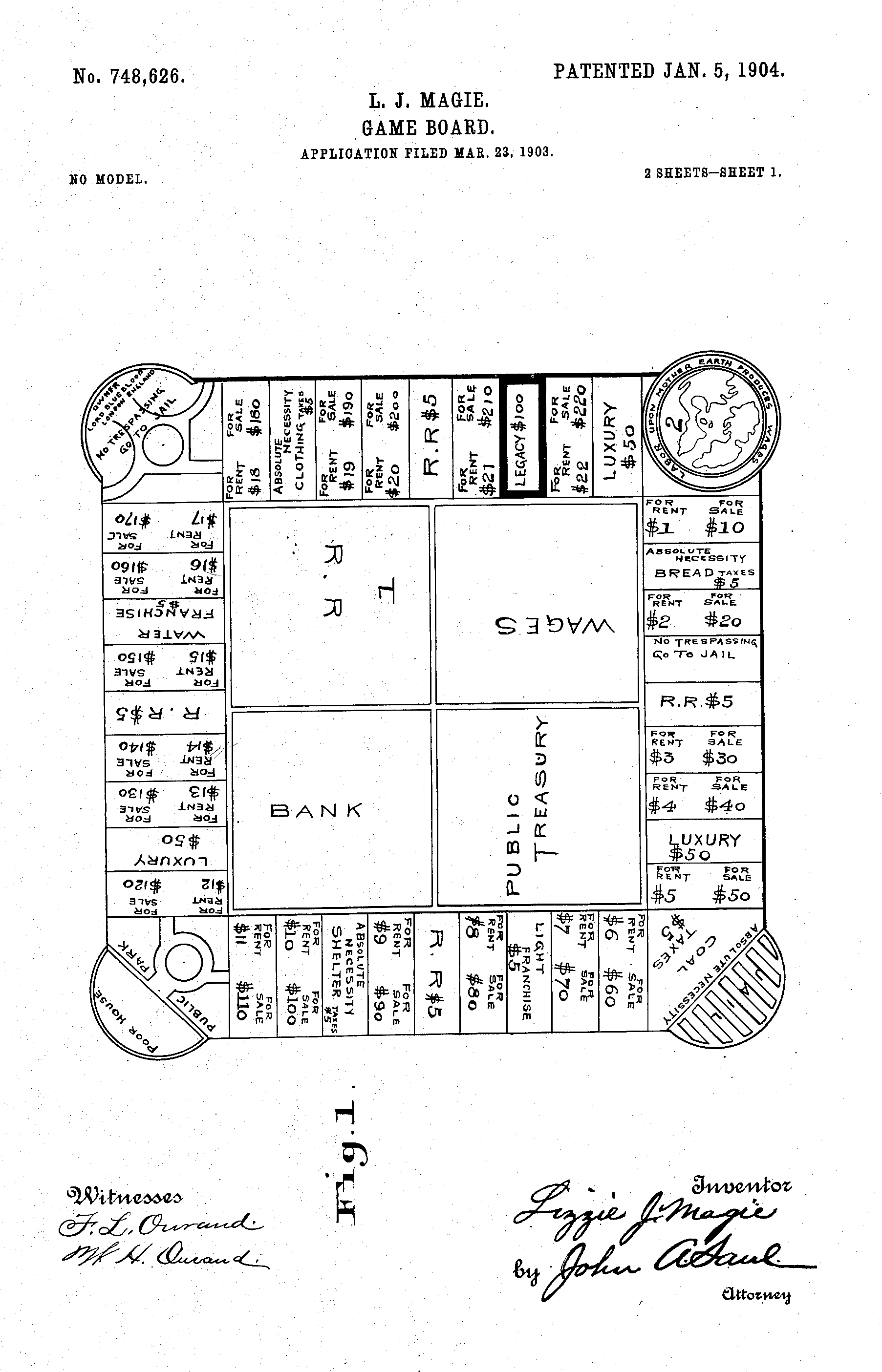
Leaving aside the bizarrely chosen hyperbole (27 languages INCLUDING CROATIAN?!?!?), and ignoring obvious inaccuracies (describing Monopoly as a "phenomenal pastime", claiming that the game "let[s] everyone enjoy a taste of the high life"), this obviously simplified version of events ignores the notion that games similar to Monopoly were fairly widely played at home at the beginning of the twentieth century. A sadly unsourced wikipedia cites the most famous pre-Monopoly game called The Landlord's Game created and patented by Elizaberth Magie, a Quaker:
The Landlord's Game is a board game patented in 1904 by Elizabeth Magie. It is a realty and taxation game, similar to Monopoly. Though many similar home-made games were played at the beginning of the 20th century and some predate The Landlord's Game, it is the first of its kind to have an attested patent. Magie re-patented a revised edition of the game in 1924. The United States Patent numbers are 748,626 and 1,509,312.

Magie based the game on the economic principles of Georgism, a system proposed by Henry George, with the object of demonstrating how rents enrich property owners and impoverish tenants. She knew that some people could find it hard to understand why this happened and what might be done about it, and she thought that if Georgist ideas were put into the concrete form of a game, they might be easier to demonstrate.

File:BoardGamePatentMagie.png

A patent drawing for The Landlord's Game

Fairly radical, no? There's a lot to love about Quakers. This game was passed around for a while at the beginning of the century, and then... well, then the rags-to-riches story of Charles B Darrow kicks off. A website called The Idea Finder takes the second half of the story up (after, it turns out, providing the text for the above-quoted wikipedia article):
In 1933, Charles B. Darrow played a game on oil cloth on his kitchen table, fell in love with the game's exciting promise of fame and fortune. He played "Monopoly" at home with his family and friends. But others soon heard of the game and ordered sets of their own. Later that year Charles Darrow patented and sold copies of the game as his personal invention. Darrow went to work, making hand-made copies of Monopoly and selling them for $4.00 apiece.

When demand for the game grew beyond his ability to fill orders, he brought the game to Parker Brothers who first rejected it on the basis there were 52 design errors. Undaunted, Darrow continued to produce handmade editions on his own and was highly successful. Parker Brothers caught wind of the success and decided to buy the rights to the game. In 1935, owned by Parker Brothers, the MONOPOLY® game became America's best selling game. Parker Brothers subsequently decided to pay off Magie, and others who had copyrighted commercial variants of the game, in order to have legitimate, undisputed rights to the game, and promoted Darrow as its sole inventor.

But hang on!
"A game surprisingly similar to Darrow's and known as Monopoly was played on homemade boards in the DKE house at Williams College in 1927 et seq. It developed in Reading, Pa., much earlier than that.

"Almost exactly this same game as played at Williams was put on the market in Indianapolis early in 1932 through L. S. Ayres & Co. The name was changed to Finance for trademark reasons. Dan Layman's predecessor Finance. That cost more money: $10,000. But none of it went to Layman. A victim of the Great Depression, broke and desperate for money, he had sold his interest in Finance to a small games manufacturer, David W. Knapp, for $200.

This is getting complicated.
Once Finance was wrapped up, Parker Brothers turned to another Monopoly-like game called "Inflation," manufactured by a Texan named Rudy Copeland. Early in 1936 Parker Brothers sued Copeland for patent infringement. Copeland countersued, charging that Darrow's and therefore Parker Brothers' patent on Monopoly was invalid. If the details forming the basis for that charge had become public knowledge, Parker Brothers might never have gone to reap a fortune from Monopoly. But Parker settled the lawsuit immediately by paying Copeland $10,000 to surrender his rights and keep his mouth shut.
Whoah! And a final word on this ugly little game?
Decades later, when they [Parker Bros] attempted to suppress publication of a game called Anti-Monopoly, designed by Ralph Anspach, the trademark suit went all the way to the Supreme Court of the United States in 1983, and the court found in favor of Anspach because Darrow did not actually invent the game.
Whammo! Litigously sordid! Thanks, Idea Finder!!

There's even more depth on the whole story, with rules to preliminary versions of Monopoly, on this site.

I'm with this guy at his blog, Lutheran Surrealism, who decides the following after two of his children refused to continue playing:
"I'm against monopolies, and I realized while playing the game that it taught something evil. The idea is to control all the properties on the board, and squeeze the viability out of your playing partners until you win, by forcing them all out of business. Perhaps my two boys knew something, or sensed something, after all, about the game."

"It's a wicked, wicked game."

AND A BLOODY GREAT QUOTE FOR YOUR WEEKEND:

"What matters is being right, not being told you are"

Which is useful, as very few people tell me I am right.

Thursday, 5 February 2009

Thursday, 5th February

Today in 1953...

"Sweet rationing ended in Britain after ten years"


http://farm3.static.flickr.com/2058/2229372024_b5c70fe7fa.jpg?v=1201736689

From the BBC "On This Day" microsite:
"Rationing came into force on 8 January 1940, a few months after the start of World War II.

All sorts of essential and non-essential foods were rationed, as well as clothing, furniture and petrol. Rationing of sweets and chocolate began on 26 July 1942.

The process of de-rationing began in 1948, but made slow progress until 1953. Then Food Minister Gwilym Lloyd-George made it a priority for his department.

As well as sweets, he took eggs, cream, butter, cheese, margarine and cooking fats off the ration books."

and the quote....

"Never light a fire you can't put out"

An anonymous quote again (in which case it was probably Churchill), searching for this in quotes yields 5 results. They are, in full:
  • Part of the "signature file" on a website about New Eden, which seems to be a game based on the BBC series Torchwood. Not sure what this means, as the network at the office bans sites about gaming. I suspect it's part of a file which randomly generates signature quotes on forum postings, or something.
  • A chinese blog consisting of softcore pictures of gay western men
  • "Thought for today" from user foxylady on 20six.com (most likely from her desk calendar, I reckon)
  • A page from the defunct-seeming (ie it won't load and all I have to go on is the google search result) theMSSforum.com site. The full text of the search result is "somthing[sic] new a drunk isirsh[sic] man onced[sic] said never light a fire you can't put out you will learn somthing[sic] new everyday[sic] Tag: Where are you? Tag: 111332 ..."[sic]
  • The 15th page of a thread from 2007 in a Maximo Park forum. It seems like somewhere around page 4 or 5, someone began a discussion about bandmember Paul not speaking to fans outside the Manchester gig. User purdylola said:
    "Went round the back after and waited over two hours for them to come out. At one point Paul appeared with two girls but he had his head down and swiftly passed through so we assumed he would come back after, but he never did!!!! However i did meet Archis and adorable Duncan who i spoke to for about 20 minutes. Lukas and Tom were also buzzing around. But seriously, what the hell Paul!!!!!! V disappointed, not what i expected, he upset some fans tonight."
    Which obviously 'ignited' a discussion. Ten pages of forum posting later, someone throws that "Dont start a fire" quote right in her face. Nice one!

Wednesday, 4 February 2009

Wednesday 4th February!!!

Today in 1974...

"American Heiress Patty Hearst was kidnapped by urban guerillas"


Heiress-cum-urban-guerilla, Patty Hearst

Well, I've been away a while... Blame both the snow, which has crippled our nation, and my own laziness, which has crippled my advance through life.

Anyway, i can't turn down a good hostage story, so...

Patty Hearst was an heiress to the Hearst publishing empire established by William Randolph Hearst (the inspiration for Citizen Kane), who was her Grandfather.

The timeline of her kidnapping is extraordinary. She was kidnapped on this day in 1974 and by April she was caught on security camera (above), appearing to take part in an armed robbery of the Hibernia Bank in the Sunset District of San Francisco. Her journey from victim to apparent collaborator ("Tania") was quick to say the least. The organisation which took Hearst, the Symbionese Liberation Army, demanded a food program be set up for the poor people of California and in the ensuing weeks Hearst's public pronouncements, which appeared to side with her captors, enthralled the press and public - and probably confounded her father.

The best place for infos is definitely the PBS microsite for the documentary "Guerilla: The Taking of Patty Hearst" including a timeline, resources (the Rolling Stone 1975 article is fascinating) and a bizarre and incredibly basic role-playing game called "What's Your Bag?" where you choose whether you want to be a revelutionary or not...

Here's some video, too, of contemporaneous CBS coverage of the kidnap:


Click on for Parts 2, 3, 4, 5 and 6

And some more video here:


And today's "daily desk quote":

"Conscience is the inner voice that warns us someone may be looking" - H. L Mencken

My conscience is telling me I should get back to work having wasted an entire afternoon looking up stuff about Patty Hearst.